


















A server does not need to be old or neglected to become a security risk. One overlooked safeguard on a newly installed system could give attackers an opening into the wider company network.
Microsoft announced the Windows Server 2028 public preview on Nov. 17. Starting with Insider build 29706, Server Core turns on hundreds of security settings at first boot, including stricter controls for remote administration and file sharing.
For IT teams, the preview is a chance to find which tools depend on older settings before those dependencies become a migration problem.
Stricter controls protect logins and remote connections
Microsoft describes changes to how servers handle user logins and access to sensitive information. Windows Server 2028 favors Kerberos over NTLM, an older sign-in method that attackers can exploit to impersonate legitimate users. Additional safeguards protect stored credentials and make repeated password-guessing attempts harder.
Other protections cover network activity and administrator access.
- Network security. File-sharing connections receive stronger protection against tampering and interception, while the built-in firewall stays enabled to block unwanted traffic.
- Remote access. Older and less secure methods of connecting to servers are restricted, like administrative connections that send information without encryption.
- Activity monitoring. More detailed records of commands, including PowerShell activity, give investigators additional information when examining suspicious behavior.
Many settings are enforced through system policies that ordinary software installers and setup scripts cannot simply disable. Administrators must change the controlling policy before making exceptions to those protections.
Older applications could run into compatibility problems
Programs built around outdated login methods or network connections may struggle under the new restrictions, though. Businesses using older management tools or complex Active Directory environments could face additional work getting existing software to operate as expected.
Microsoft provides an example involving Windows Remote Management, which allows administrators to control servers from another computer. Attempts to restore an insecure login method through a local command are blocked, but a separate utility can return an entire group of settings to standard Windows Server behavior. Doing so may remove several protections within that group, not just the one causing trouble.
Some planned safeguards are also missing from the current preview. Complete blocking of NTLM remains under development, as well as additional protections against unauthorized hardware access and certain remote connections.
Official release notes also identify a bug that can crash a Windows authentication service during certain encrypted connections.
Security teams must check which protections remain active
Enterprise security architects and Windows Server administrators should pay attention to what happens when an application needs an exception. Loosening a setting may get the software working again, but it could also leave the server with fewer defenses than intended.
Changes made for one system can eventually spread to others through shared installation scripts or company-wide policies.
A structured review before deployment can help teams identify compatibility problems while keeping necessary security exceptions under control.
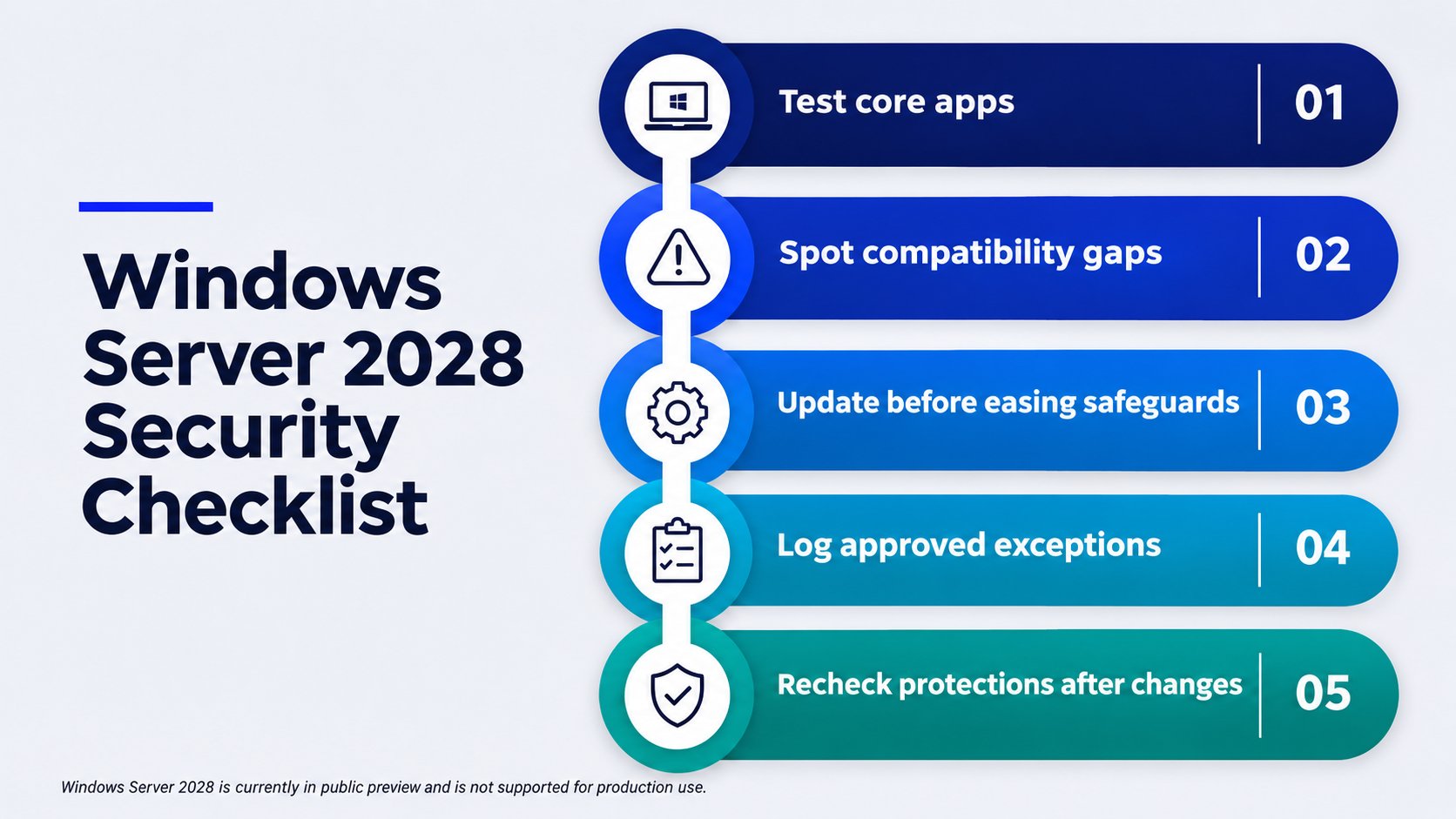
Checking the results is not always straightforward. Microsoft warns that familiar Windows policy reports can display certain protections as Not Configured even when they are active.
Its MSHardenedPolicyEval tool can assess the settings actually in force. However, the current preview does not yet measure every safeguard.
Organizations using security configuration management tools together with Group Policy or OSConfig should also establish which system controls each setting.
Competing tools can overwrite one another's changes, leaving servers in an unexpected state. Regular checks after approved changes will help enterprises maintain Windows Server 2028's stronger protections as applications and security policies evolve.
More cybersecurity news: Oracle's latest security update addresses hundreds of vulnerabilities, but Java installations hidden inside enterprise software could remain overlooked.