


















A security patch can also become an attacker’s starting point.
In a Nov. 16 report, Google Threat Intelligence Group said it had found attackers configuring AI to develop and execute exploits without someone directing every step. Organizations running unpatched software could face a shorter window before newly disclosed vulnerabilities are targeted.
Applying a vendor's update is rarely instantaneous across an enterprise. Attackers can begin working from the same security disclosures while administrators are still preparing to deploy a fix.
Inside the attacker-hosted exploit framework
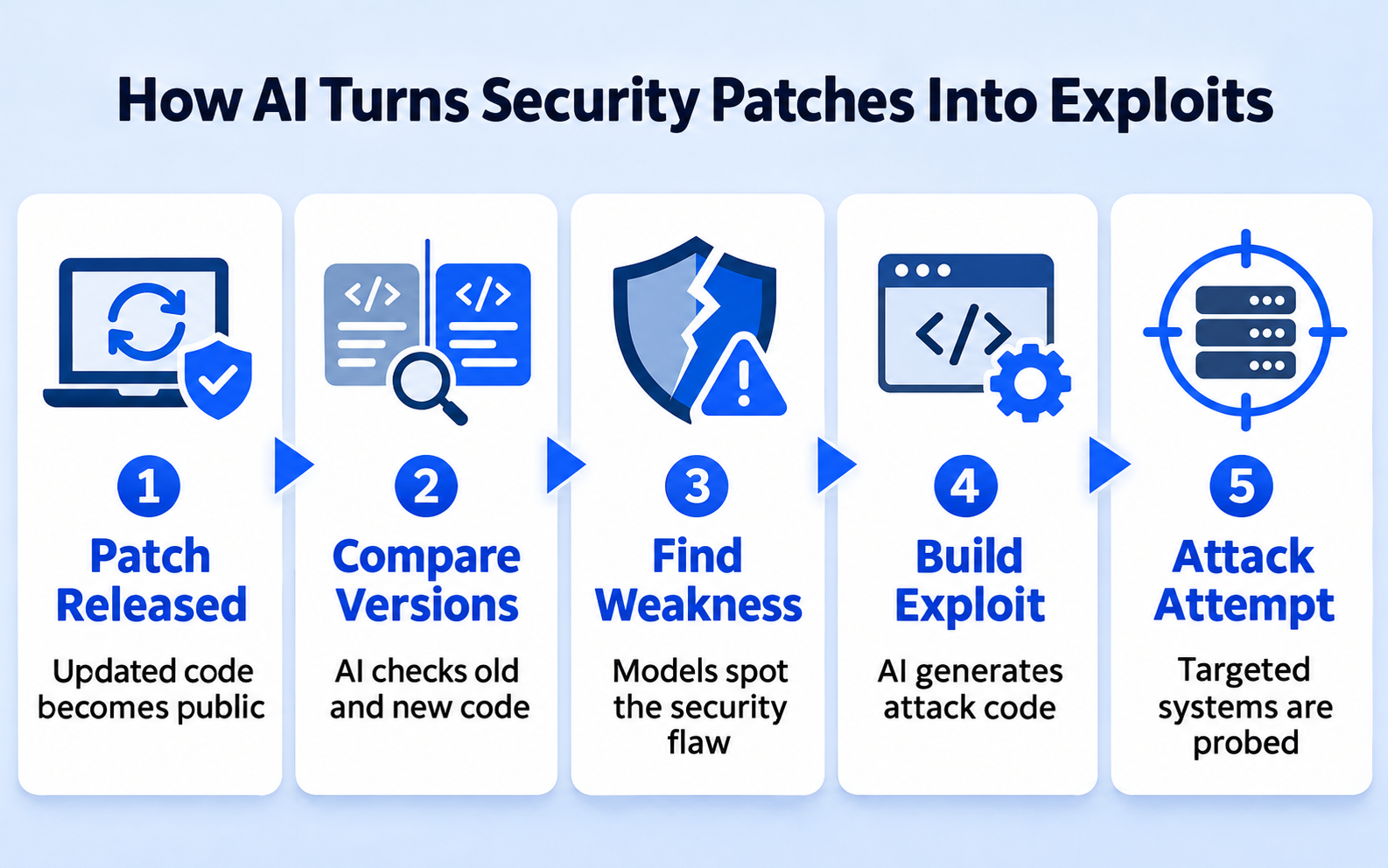
Investigators discovered a framework called exploit_agent on an exposed attacker-controlled server, where it was connected to multiple advanced and locally hosted AI models. According to Google's findings, the system was configured to continuously examine popular web applications for security updates.
By comparing software code before and after a patch, the framework could identify potential vulnerabilities, generate exploit code, and attempt to execute it automatically.
One documented example involved the system examining access controls in version 2.19.25 of Spectra, a WordPress plugin.
Investigators also recovered stolen victim data and scripts capable of password guessing, internal reconnaissance, and installing webshells. Activity recorded on the server suggested interest in French websites associated with media, entertainment, and education organizations.
Early patch information can accelerate exploit development
Google documented another example involving two PHP vulnerabilities, CVE-2026-109618 and CVE-2026-109619, discovered through AI-assisted analysis. Before the official Oct. 21 patches were released, a demo video and early patched code had already appeared online, allowing researchers and potential attackers to study the flaws and attempt to develop exploits.
The company said hundreds of claimed but nonfunctional proof-of-concept exploits appeared in the days after the patches, likely generated with AI assistance. The unreliable code added verification work for security teams monitoring for confirmed exploitation.
In a separate September vulnerability analysis, Google reported observing an average of 18 exploited vulnerabilities per month during the first eight months of 2026, up from 10.5 in 2025. Much of the increase involved previously disclosed flaws, while exploitation of previously unknown vulnerabilities rose more modestly.
How to reduce exposure while systems await security patches
Security teams cannot always install fixes immediately, particularly when internet-facing applications require testing or scheduled downtime. Attackers can move much faster, sometimes within minutes of public exploit code appearing. Until updates are deployed, administrators need to know which systems remain exposed and how to limit access to them.
Teams responsible for internet-facing web applications should prioritize three actions.
- Identify exposed software before scheduling fixes. Match new security advisories against the actual versions of public-facing applications and plugins. Use an up-to-date inventory of internet-accessible systems to establish which installations remain vulnerable, whether attackers can reach them, and who is responsible for remediation.
- Restrict access when immediate patching is not possible. Applications awaiting compatibility testing or maintenance approval should not remain unnecessarily exposed. Administrators can limit public access to affected services, disable vulnerable features where feasible, and apply vendor-approved mitigations until updates are deployed. Temporary protections should be verified and tracked through the organization's vulnerability patching process.
- Check for compromise before closing the issue. Installing a security update does not establish whether attackers exploited the vulnerability beforehand. Review application and authentication logs from the exposure period for suspicious requests, unexpected administrative accounts, or unauthorized server changes. Any evidence of compromise requires investigation beyond applying the patch.
Verify both the installed fix and the status of previously exposed systems before considering remediation complete. Faster patch deployment reduces the opportunity for exploitation, but it cannot undo unauthorized access that may have occurred while vulnerable software remained online.
Understanding how AI works can help security professionals assess both its benefits and its risks. eSecurity Planet readers get free 7-day access to The Neuron Academy, our practical learning platform designed to help professionals use AI more confidently at work. Browse all lessons →
Let us teach you How to Talk to AI for free! Try our six-minute course at The Neuron Academy and learn a few simple ways to write better prompts and get more useful results from AI, or browse our other AI course for free for seven days. Check out all the lessons here →