















AI agents are increasingly being asked to perform tasks that require access to personal and business accounts. But giving them passwords creates a security problem: an agent may need to use a credential without needing to know it.
1Password is introducing an approach designed to let AI agents sign in to supported services without directly exposing users' passwords. Instead, credential access is mediated through 1Password, with users retaining approval controls.
The feature could reduce one of the risks associated with agentic AI, but it leaves a larger question unanswered: What happens after an agent successfully logs in?
How 1Password says the feature would work
Rather than handing passwords directly to an AI agent, 1Password says its integration allows users to authorize access to saved credentials when an agent needs to sign in to a supported service.
The company says the process is designed to keep the underlying password hidden from the agent while allowing it to complete the login.
That distinction matters because a password is a reusable secret. Preventing agents from directly accessing it could reduce the risk of credentials being exposed through agent conversations, logs or other systems involved in executing a task.
In other words, the agent knocks on the door, the user approves it, 1Password unlocks the door, and the agent never touches or sees the key.
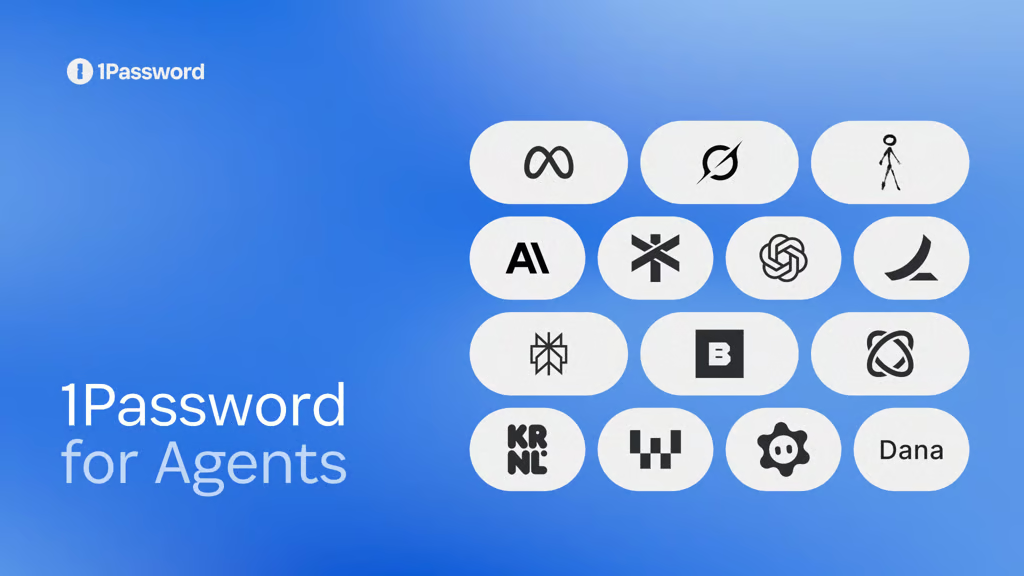
1Password says the feature is rolling out across supported AI platforms, including Meta Muse and SpaceXSI's Grok, with integrations for OpenAI, Anthropic, and other partners announced as forthcoming.
The rollout is phased, however, meaning support for every named agent should not be assumed to have been available immediately at launch.
The company says the feature is available at no additional cost to Individual and Family subscribers.
Keeping passwords hidden doesn't eliminate privacy risks
Keeping credentials hidden from an AI agent does not necessarily prevent the agent from learning which services a user accesses.
To complete a task, an agent may need information about the website, account or service involved. Depending on the integration and the permissions granted, that information could reveal details about a person's online activities.
The extent of that exposure depends on what information the agent receives and how the AI provider handles it. Protecting passwords therefore addresses one security risk without necessarily eliminating broader privacy concerns.
Another concern is control over what an agent does after gaining access.
Recent events have shown how difficult it can be to control an AI agent's behavior, particularly when it can interact with external websites, process information, and act on a user's behalf.
An agent could still make mistakes, misinterpret instructions, or encounter malicious instructions on a website that influence its actions.
That is where the distinction between controlling access and controlling behavior becomes important.
What this means for individuals and enterprises
For individuals, 1Password's new feature lets you delegate tasks to AI agents without handing them passwords to personal accounts. This reduces the risk of exposing reusable credentials in an agent's chat or context, but users should still consider whether the privacy trade-off is worth the convenience.
Users who don't use much agentic AI can keep using the older method of filling in passwords, which, on browsers that support 1Password's extensions, lets you fill in your passwords without necessarily typing them.
For enterprises, the stakes could be higher. If organizations share credentials directly with AI agents, they risk exposing secrets that could provide access well beyond the task at hand.
A system that mediates credential access can reduce that exposure. However, enterprises still need policies governing which agents employees can use, which accounts those agents can access, and what actions they can perform.
Security teams should also examine whether agent access can be limited to specific accounts or tasks, whether approvals and activity are logged, and how quickly permissions can be revoked. Even when an agent never sees a password, an authenticated session may still allow it to view sensitive information, change settings or perform actions beyond what the user intended.
Other news: A reported security breach involving cloud deployment platform Zeabur has raised concerns about account protection and how providers respond to affected customers.