
















Cybercriminals are using AI to write malicious code, automate attacks, and adapt malware when security tools detect it. Some of these capabilities are being marketed through unrestricted AI services designed for criminal use.
One example is DIG AI, a Dark Web assistant that was investigated by the cybersecurity firm Resecurity in 2025. The service demonstrated how attackers could generate malicious scripts without the safeguards found in mainstream AI platforms. Research published in 2026 by Anthropic and other security firms has since documented AI-assisted cyber intrusions, malware modification, and automated data theft.
For security teams, the concern extends beyond individual hacking tools. As AI reduces the expertise and manual effort required for certain attacks, organizations must prepare for adversaries capable of automating more of the intrusion process.
What is DIG AI?
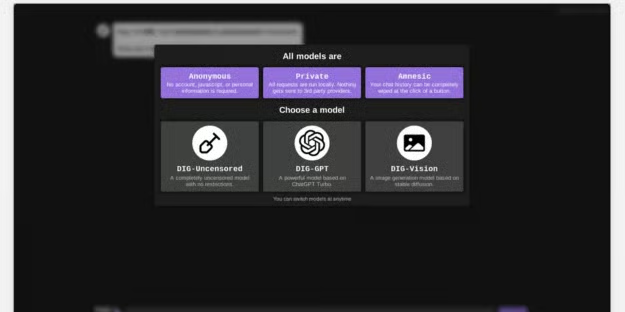
DIG AI is an uncensored artificial intelligence assistant that Resecurity first identified in September 2025. Accessible through the Tor network, the service can generate content that mainstream AI platforms typically restrict.
Resecurity researchers found that DIG AI could produce malicious scripts capable of compromising vulnerable web applications. The tool also generated fraudulent content that attackers could use in scams.
According to the original investigation, DIG AI required no user registration. Its operator, known as "Pitch," claimed the service was based on ChatGPT Turbo, although researchers did not independently verify the underlying model.
Researchers also found advertisements for DIG AI on underground marketplaces associated with illicit commerce. These findings highlighted an emerging market for AI services promoted to criminal audiences.
Beyond cybercrime, Resecurity warned that unrestricted AI systems could facilitate extremist propaganda and the creation of child sexual abuse material (CSAM). Such capabilities create additional challenges for law enforcement because anonymously hosted services can be difficult to investigate.
Criminal AI services are expanding in 2026
DIG AI was not an isolated development. Other unrestricted AI services have appeared in underground communities, offering capabilities intended to support criminal operations.
A report from Flashpoint highlighted MessiahGPT, an unrestricted large language model (LLM) marketed for malicious purposes. The service gives users access to capabilities they might otherwise lack the technical expertise to develop themselves.
Flashpoint also recorded nearly 7.5 million posts discussing AI and criminal activities in August 2026, representing a 34% increase from July. Discussions involving AI-enabled identity verification bypass methods nearly doubled during the same period.
These figures reflect activity in criminal forums rather than a confirmed increase in cyberattacks.
How cybercriminals are using AI in real-world attacks
The threat extends beyond purpose-built criminal AI platforms. Attackers are increasingly misusing legitimate AI assistants to support cyber operations.
Anthropic documented a threat actor using AI-assisted workflows during cyber intrusions. The attacker automated phishing infrastructure and used AI agents to monitor malware detection. When security products identified malicious code, the agents attempted to modify it to evade detection.
The operation also involved AI-assisted credential theft. Automated workflows helped process and exfiltrate stolen data, reducing the manual effort required to sustain the attack.
Palo Alto Networks Unit 42 also documented an attacker who used AI-generated scripts to compensate for limited technical expertise.
The attacker compromised an Indian university and exfiltrated more than 5,200 records containing personal information. Researchers also observed the actor using AI to support telecommunications fraud and other malicious activities.
Why AI-enabled cybercrime challenges defenders
Criminal AI tools can reduce the time required to execute cyberattacks by automating tasks that previously demanded continuous human involvement.
Attackers can use AI agents to accelerate reconnaissance and modify malicious tools when defensive controls interfere with their operations.
However, not every AI-enabled threat represents a sophisticated autonomous attack. An analysis of malware by Unit 42 found that most AI-related malware samples examined were research projects or proof-of-concept demonstrations rather than actual threats.
How organizations can defend against AI-powered threats
Security teams should focus on detecting malicious behavior rather than determining whether content or code was generated by AI.
- Strengthen behavioral detection. Monitor for automated reconnaissance targeting internet-facing systems. Investigate unusual activity that could indicate AI-assisted attacks.
- Expand threat intelligence coverage. Track emerging criminal AI services and incorporate verified attacker techniques into detection rules. Prioritize intelligence tied to active campaigns.
- Harden identity security. Enforce phishing-resistant MFA and least-privilege access to limit the impact of compromised credentials. Monitor privileged sessions for suspicious activity.
- Test incident response capabilities. Include AI-assisted intrusion scenarios in tabletop exercises. Test whether automated containment can stop attacks before they spread.
These measures can help organizations detect AI-assisted threats earlier and limit their impact.
The evolving threat of criminal AI
DIG AI's discovery in 2025 provided an early warning about the misuse of unrestricted artificial intelligence. Subsequent research has shown how attackers are incorporating AI into established cybercrime techniques.
For security teams, the priority is ensuring that defensive controls can detect and contain attacks as cybercriminals become more reliant on automation.
Related reading: Organizations can help strengthen their overall defenses by following a SecOps playbook for AI-powered threats.