
















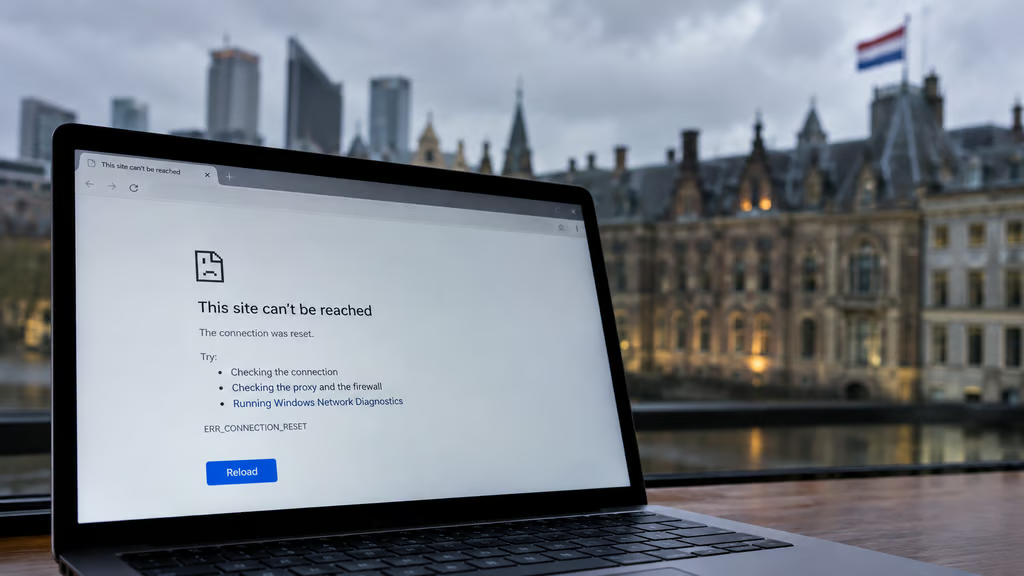
Government websites across Europe went dark Wednesday as organizations scrambled to protect their systems from critical security flaws in PHP.
Government agencies in the Netherlands were among those that temporarily suspended public services on Oct. 21, while schools and hospitals elsewhere in Europe also took websites offline, according to Reuters. The precautionary shutdowns followed warnings that two PHP vulnerabilities could allow attackers to execute malicious code on affected servers without authentication.
Emergency patches are now available, but the disruption illustrates how a software vulnerability can interrupt essential services even before a successful cyberattack is confirmed.
- Dutch government services taken offline as a precaution
- Emergency patches released after widespread disruption
- Reports of early attacks add to the urgency
- Restoring services requires more than installing patches
- Why precautionary shutdowns create a difficult trade-off for public services
- What the government shutdowns reveal about security preparedness
Dutch government services taken offline as a precaution
The Dutch government confirmed that several public services, including Overheid.nl, MijnOverheid.nl, and DigiD, were temporarily taken offline on Oct. 21.
Officials said there were no indications of active exploitation at the time of the announcement. The shutdowns were intended to reduce the risk of compromise while administrators awaited security updates.
Not all government websites were affected. Authorities noted that many Dutch government sites, including Rijksoverheid.nl, do not use PHP and were therefore not exposed to these particular vulnerabilities.
The Netherlands' National Cyber Security Centre (NCSC) also temporarily took its own website offline. In an official notice, the agency directed organizations to alternative advisory channels while it worked to restore access.
Reuters reported similar precautionary shutdowns involving government, education, and healthcare websites elsewhere in Europe.
The European Union's cybersecurity response team, CERT-EU, had advised organizations unable to apply fixes immediately to consider isolating affected internet-facing applications from public networks.
The shutdowns were therefore not necessarily evidence of successful attacks. They reflected decisions by administrators to limit exposure until vulnerable systems could be secured.
Emergency patches released after widespread disruption
The security scramble followed the disclosure of two critical PHP vulnerabilities, CVE-2026-109618 and CVE-2026-109619, both rated 9.2 under CVSS v4.0.
The flaws could allow unauthenticated remote code execution under certain conditions, potentially giving attackers the ability to run malicious commands on vulnerable servers.
eSecurity Planet previously reported on the critical PHP vulnerabilities and emergency patching warnings. The latest development is the disruption caused as organizations responded to the threat.
On Oct. 21, the PHP development team released fixes in versions 8.5.12, 8.4.27, 8.3.36, and 8.2.35.
The project urged administrators to update immediately, warning that installations serving web requests could be affected across several deployment configurations, including Apache with mod_php, PHP-FPM, and php-cgi.
Organizations running unsupported PHP versions face additional challenges. Some operating system and long-term-support vendors may provide backported fixes, but administrators must confirm whether their installations are covered.
The availability of patches gives affected organizations a path toward restoring services. However, applying an update does not automatically establish that a system is safe to bring back online, particularly if administrators suspect suspicious activity occurred before remediation.
Reports of early attacks add to the urgency
The vulnerabilities prompted heightened concern after information about them circulated publicly ahead of the scheduled security release.
Reuters reported that Cloudflare had observed early attack activity targeting the flaws, while Australia's cybersecurity agency said it was not aware of active exploitation at the time.
Those statements describe different observations and do not establish widespread successful compromise.
The Dutch government likewise reported no indications of active exploitation when it announced its precautionary shutdowns.
Still, the possibility of attackers targeting exposed systems created an immediate operational problem for organizations responsible for keeping public-facing services available.
The UK's National Cyber Security Centre advised organizations to identify PHP installations, monitor internet-facing systems for malicious activity, and apply updates as soon as possible. Where immediate remediation was not feasible, it recommended considering taking affected systems offline.
Restoring services requires more than installing patches
With emergency fixes available, affected organizations must determine when their systems can safely return to normal operation.
Security teams should verify that updates have been applied to the relevant PHP installations, including those embedded in third-party applications or maintained by external providers.
They should also review available server logs for suspicious activity and investigate any indications of compromise before restoring affected services.
Where a breach is suspected, eSecurity Planet's incident response guide outlines the importance of containment, investigation, recovery, and post-incident review.
The disruption also raises questions about how quickly organizations can coordinate emergency changes across systems they do not manage directly.
A government service or business application may depend on a hosting provider, software vendor, or external IT team to deploy an update. Even after a fix becomes available, those dependencies can complicate recovery.
For organizations that operate essential online services, understanding who maintains each component is therefore as important as knowing which systems are vulnerable.
Why precautionary shutdowns create a difficult trade-off for public services
Taking vulnerable websites offline can reduce the risk of exploitation, but it also creates a different problem: people may temporarily lose access to essential online services.
The Dutch government's decision to suspend access to services including Overheid.nl, MijnOverheid.nl, and DigiD illustrates that trade-off. These platforms support interactions between residents and government agencies, meaning even precautionary disruptions can interfere with everyday administrative tasks.
For government IT teams, the decision involves balancing two competing priorities: protecting sensitive systems from potential compromise and maintaining access to services the public relies on.
The consequences can extend beyond government agencies. Businesses that depend on public-sector authentication systems, online portals, or third-party integrations may also experience disruptions when those services become unavailable.
The incident raises three important business-continuity questions:
- Service prioritization: Which public-facing applications must remain available, and which can be temporarily suspended?
- Alternative access: Can residents and businesses complete essential transactions through other channels during an outage?
- Recovery coordination: How quickly can agencies verify that systems are secure and restore access without introducing additional risks?
The PHP shutdowns demonstrate why emergency vulnerability response plans must account for service availability alongside technical remediation. Even when no successful cyberattack has been confirmed, the precautions necessary to prevent one can carry significant ope
What the government shutdowns reveal about security preparedness
The PHP incident shows how a serious vulnerability in widely used software can become a service availability problem without a confirmed breach.
Taking a website offline may prevent exploitation, but it can also interrupt access to government services, healthcare information, and other resources people depend on.
Businesses face similar decisions when vulnerabilities affect customer portals, payment systems, or internal applications.
The immediate priority is to secure affected systems and restore services safely. The longer-term lesson is the need for accurate software inventories, clear patching responsibilities, and recovery procedures that can be activated without delay.
Those capabilities are central to effective network security practices, particularly when organizations depend on third-party software and infrastructure.
For security leaders, the question extends beyond whether their PHP installations have been patched. It is whether they know which critical services depend on vulnerable components, who is responsible for securing them, and how quickly those services can be restored when the next emergency arrives.
Other news: Meta has suspended its Muse AI chat-sharing feature after security researchers discovered more than 6,800 conversation links through passive DNS records.