















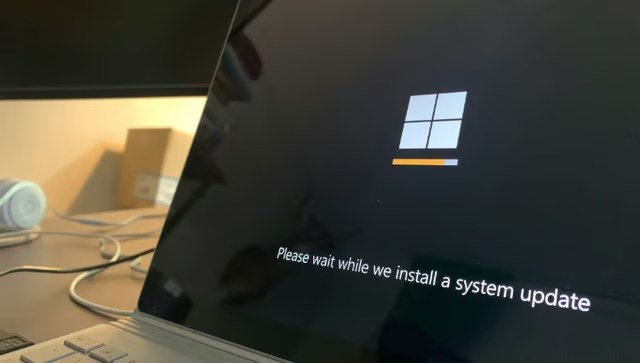


Microsoft just had to patch its own patch.
Last week's September Patch Tuesday was Microsoft's biggest ever, closing out roughly 974 unique vulnerabilities in one release. That single update outpaced everything Microsoft patched in all of 2023.
However, the massive fix came with a cost: Remote Desktop Services started failing, Hyper-V-based Linux virtual machines lost access to shared folders, and some USB audio devices went silent.
The damage rippled into everyday tools. Anthropic's Claude Cowork and the Windows Subsystem for Linux both broke due to a change in how Windows shares folders with Linux virtual machines. Anthropic told users that a Windows update had left Claude Cowork on Windows unable to run local commands because its workspace could no longer access the computer's drive, though chat, file reading, and editing still worked for most people.
The emergency patch
On Monday, Microsoft pushed out KB5129195 for Windows 11 24H2 and 25H2, along with companion updates for 26H1, Windows 10, and several server versions. The fix installs automatically, takes about 10 minutes, and typically needs just one restart.
It fully resolves the Remote Desktop and virtual machine problems. Audio is a different story — Microsoft says the update restores multichannel and 3D audio modes for some USB devices, but other issues, including devices producing no sound at all, remain unresolved. AMD Radeon graphics driver crashes and File Explorer freezes reported after the original update also remain unfixed.
Why this keeps happening
Security researchers say the pattern isn't random bad luck.
Ensar Seker, chief information security officer at SOCRadar, told DarkReading that the growing complexity of interconnected operating systems, cloud services and legacy technology expands the testing matrix, making it extremely difficult to reproduce every enterprise environment before a patch ships.
Tyler Reguly of Fortra added that there's no independent body checking Microsoft's work, which is exactly why testing patches as they roll out matters so much.
What it means for you
Windows users should install Microsoft's emergency update if they're running an affected version, particularly if the September update disrupted Remote Desktop or Linux virtual machine functionality.
USB audio users should be more cautious about assuming the problem is solved. Microsoft says the update restores some multichannel and 3D audio functionality, but other audio problems remain unresolved.
For IT administrators, the bigger lesson is about deployment strategy. Two vulnerabilities addressed in the original September release were already being exploited, making prolonged patch delays risky. But the regressions also show why organizations should test major Windows updates in smaller groups before deploying them broadly.
Staged rollouts, tested rollback procedures, and dedicated update rings give administrators room to catch problems without leaving an entire environment exposed while they wait for every edge case to shake out.
Related reading: Microsoft's August Patch Tuesday created a similar dilemma for defenders, with more than 400 vulnerabilities and an actively exploited Windows zero-day forcing security teams to balance patching speed against deployment risk.