
















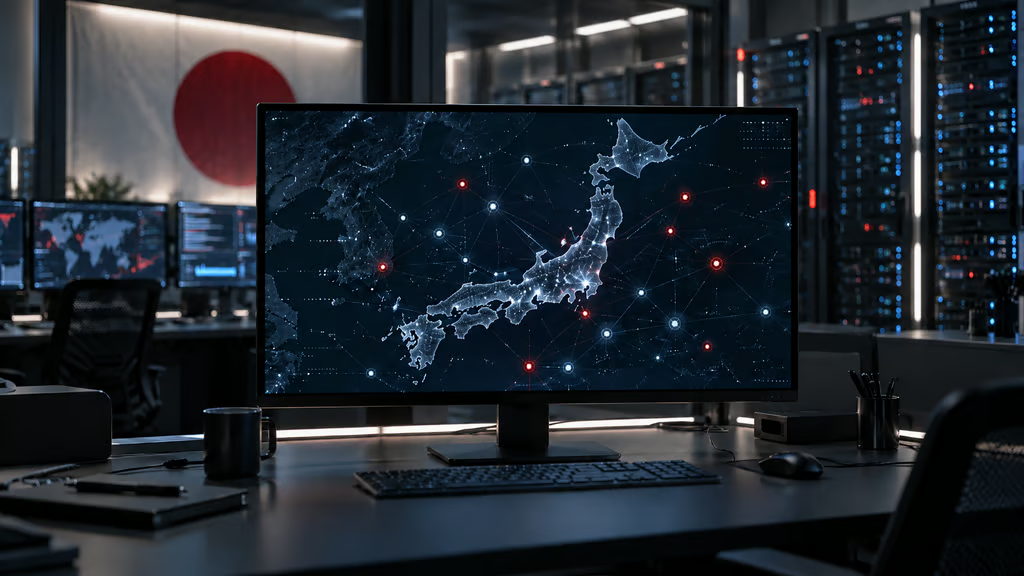
An attacker used an AI-assisted penetration-testing platform to automate cyberattack activity against organizations in Japan, demonstrating how tools designed for security testing can also accelerate malicious operations.
The October 2026 campaign involved CyberStrikeAI, an open-source platform capable of coordinating specialized AI agents for reconnaissance, exploitation attempts, and reporting. Researchers identified at least 16 Japanese organizations subjected to attack-related activity, although they did not establish that every target was successfully breached.
For security teams in Japan and across Asia-Pacific, the concern is not necessarily a new attack technique. It is how quickly AI-assisted tools can identify and test familiar weaknesses across multiple organizations.
CyberStrikeAI automated multiple stages of an attack
According to The Hacker News, TrendAI researchers found that CyberStrikeAI used 44 AI agents to automate reconnaissance, exploitation, and reporting.
“AI has increased the attackers' workforce, but the work still consists of looking for unlocked doors,” the researchers said.
At least 19 organizations, including at least 16 in Japan, underwent validation activity. The platform produced standardized reports and evidence indexes, but that does not establish successful compromise at every target. The operation adds a concrete example to concerns about AI agents being used as attack tools.
The other two environments involved different AI roles: an LLM assisted an operator in a campaign that compromised an exposed geographic information system server, while another operator used AI mainly to develop scripts targeting network equipment. Researchers found no evidence the three operations shared an operator.
Separate ARTEX activity adds to Japan's concerns
According to The Japan News, Tokyo-based GMO Cybersecurity by Ierae identified suspected ARTEX activity in attacks reportedly targeting around 80 Japanese companies. The investigation identified targets in finance, insurance, e-commerce, and digital gift cards. ARTEX is separate from CyberStrikeAI, so the two investigations' target counts should not be combined.
The newspaper also reported that Japanese officials were examining possible AI misuse, while JPCERT/CC identified signs of Claude Code in other attack environments.
TrendAI said the CyberStrikeAI operator also targeted organizations in Taiwan and Hong Kong, making the findings relevant to APAC defenders following AI-agent threats affecting Taiwan. No common operator has been established across these cases.
Japanese and APAC defenders should act on familiar weaknesses
For Japanese organizations, the priority is to check internet-facing systems before automated scanning finds misconfigurations and unpatched services. Administrators should examine VPN gateways, firewalls, remote management interfaces, and other externally accessible applications, then review logs for rapid scans and repeated authentication attempts.
“Companies should use AI to thoroughly examine their computer systems for vulnerabilities,” S & J Corp. President Nobuo Miwa told The Japan News. Organizations should follow authorized assessments with remediation, as identifying weaknesses alone does not make systems secure.
Security teams across APAC should prioritize three checks:
- Reduce exposure: Inventory external assets, disable unnecessary interfaces, remove default credentials, and prioritize patching exploitable weaknesses.
- Protect identities: Require multifactor authentication for remote and administrative access, and train staff to recognize localized fake login pages in Japanese and other regional languages.
- Detect and contain: Correlate VPN, web, identity, and endpoint logs for automated probing, unexpected privileged access, and outbound data transfers. Test escalation procedures across subsidiaries and regional teams.
Aviatrix also recommends network segmentation and tighter outbound traffic controls to limit the damage from a successful intrusion.
Segmentation can prevent attackers from moving freely between compromised systems, while monitoring outbound connections can help detect command-and-control activity or suspicious data transfers.
The 44-agent operation highlights how quickly attackers can automate multiple stages of a cyberattack. For Japanese organizations and security teams across APAC, the priority is to identify exposed systems early, detect suspicious activity, and contain threats before attackers can reach sensitive data or critical infrastructure.
Also read: Cyberattacks at GMO and Park24 in Japan have prompted customer compensation following unauthorized trading losses and a separate data breach affecting millions of accounts.