

















A major supply-chain attack compromised 18 popular npm packages — including chalk, debug, ansi-styles, and supports-color — planting malware that secretly redirects crypto transactions.
Aikido researchers noted, “What makes it dangerous is that it operates at multiple layers: altering content shown on websites, tampering with API calls, and manipulating what users’ apps believe they are signing.”
What happened?
Beginning Sept. 8, 2025, attackers pushed new, malicious versions of 18 high-traffic libraries that collectively see roughly 2 billion downloads per week.
The payload operates in the browser, hooks web and wallet APIs, and can reroute funds or token approvals to attacker-controlled accounts… even if the on-screen UI appears normal.
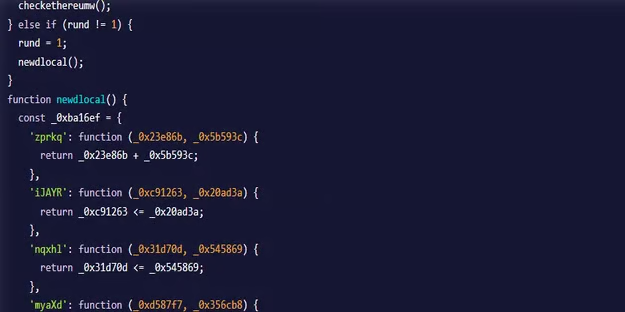
How the attack works
The malicious updates hook core browser functions, such as fetch and XMLHttpRequest, as well as popular wallet interfaces (e.g., window.ethereum, Solana).
They scan responses for wallet addresses across Ethereum, Bitcoin, Solana, Tron, Litecoin, and Bitcoin Cash, then substitute “look-alike” attacker addresses. The code also tampers with Ethereum and Solana transaction parameters before signing, silently redirecting approvals and transfers.
At a technical level, the malware acts as a browser-resident interceptor. It embeds into the page context, hooks network and wallet APIs, scans content for patterns that resemble wallet addresses, and rewrites targets using string-matching to minimize visual diffs.
For Ethereum flows, it can alter to addresses and common token functions (approve, transfer, transferFrom) and even manipulate router interactions used by popular DEXs. For Solana, it can modify instruction accounts and recipients.
The attack complexity is low once the actor controls the maintainer account; exploitability is immediate upon installation or deployment of the tainted version.
Attack Scope
The campaign traces back to a maintainer account compromise via phishing. A spoofed email impersonating npm support led to stolen credentials and subsequent tainted releases starting September 8.
Given the ubiquity of these utilities in both build and runtime paths, the potential blast radius is high even for organizations that do not directly depend on the top-level packages.
The affected versions include:
- ansi-regex (6.2.1)
- ansi-styles (6.2.2)
- backslash (0.2.1)
- chalk (5.6.1)
- chalk-template (1.1.1)
- color-convert (3.1.1)
- color-name (2.0.1)
- color-string (2.1.1)
- debug (4.4.2)
- error-ex (1.3.3)
- has-ansi (6.0.1)
- is-arrayish (0.3.3)
- simple-swizzle (0.2.3)
- slice-ansi (7.1.1)
- strip-ansi (7.1.1)
- supports-color (10.2.1)
- supports-hyperlinks (4.1.1)
- and wrap-ansi (9.0.1)
This incident underscores a broader trend, where adversaries are increasingly phishing open-source maintainers to weaponize ubiquitous “utility” packages that sit deep in transitive dependency trees.
By targeting formatting and logging libraries that land in both server and browser contexts, attackers maximize their reach with minimal effort—turning routine updates into stealthy client-side threats.
Ways to mitigate risk
Organizations impacted by the npm supply-chain attack should act quickly to contain exposure and prevent further compromise. The following steps outline how security teams can mitigate this attack.
- Remove malicious versions, clear environments, and reinstall from audited, trusted lockfiles.
- Enforce lockfiles, exact version pinning, and reviewed PR-based dependency updates in all environments.
- Rotate tokens, revoke stale credentials, enforce 2FA/SSO, and monitor for spoofed npm domains.
- Implement checks for abnormal API hooks and monitor telemetry for suspicious wallet or address activity.
- Review logs since Sept. 8, 2025, investigate wallet flows if exposed, and remediate by notifying users, resetting sessions, and clearing caches/CDN.
Just like a zero-day, one malicious update can quietly hijack critical workflows at scale.
As attacks like this show, the real challenge isn’t just patching a single package but rethinking how you secure the entire software supply chain from end to end.